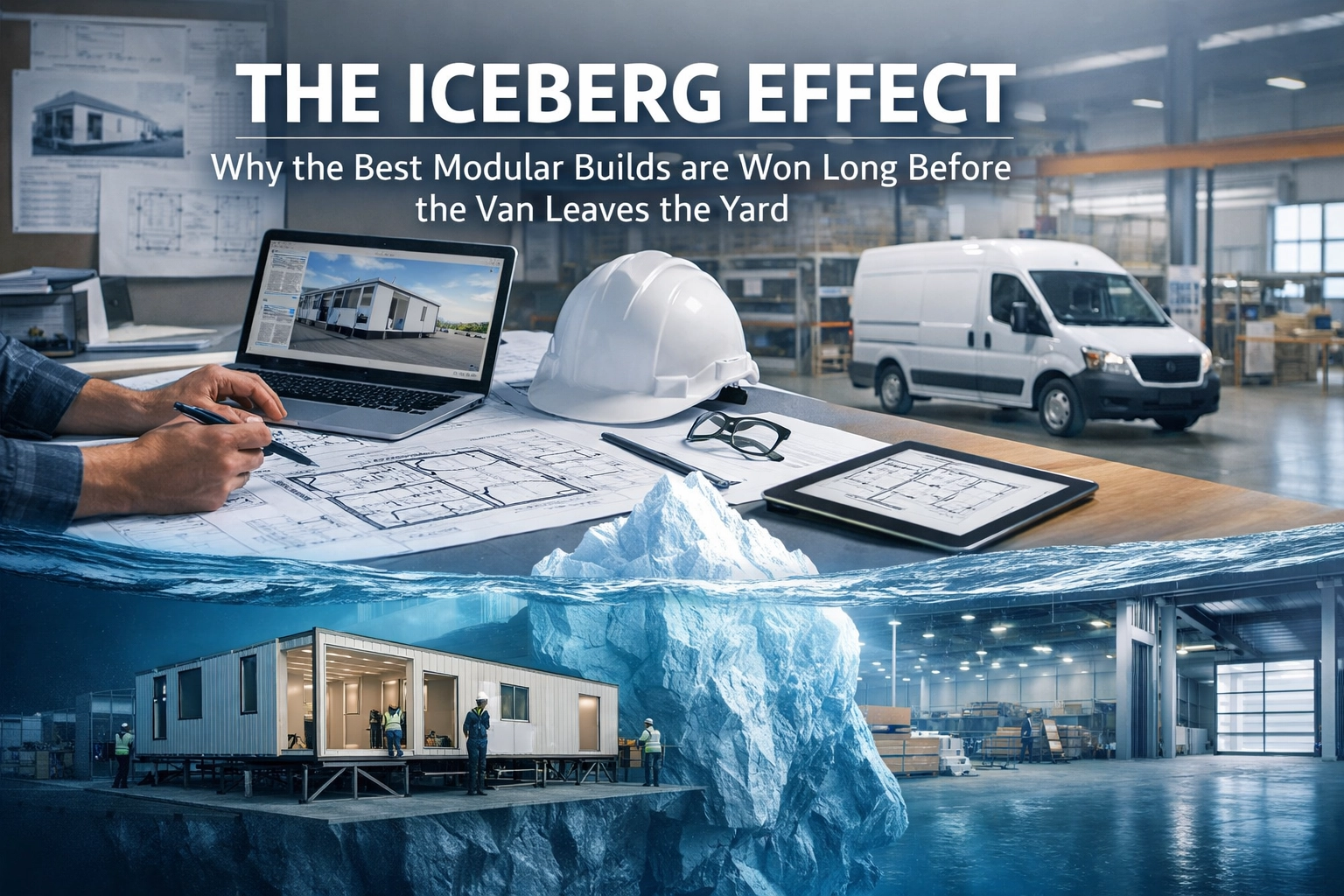
Everyone loves the spectacle of build-up day. The buzz of the venue, the race against time, the transformation from concrete floor to branded environment in a matter of hours. That's the bit people see: the 10% above the waterline.
But here's the reality: if you're watching a modular build come together smoothly on-site, the real work was done weeks ago.
That's the iceberg effect. The impressive part isn't what happens when the van doors open at the NEC or ExCeL. It's everything that happened before the crew even left the yard.
The Bit Nobody Talks About (But Should)
People think modular systems like BeMatrix are "easy." Click a few frames together, hang some graphics, job done. And sure, compared to a full custom timber build, they're faster and more forgiving. But "faster" doesn't mean "simple."
A high-end modular build: one that looks custom, functions flawlessly, and doesn't fall apart at 4 PM on day two: requires forensic-level planning. We're talking technical drawings that account for every cable run, every lighting fixture, every millimetre of tolerance. We're talking warehouse sessions where the entire stand gets pre-built, labelled, and stress-tested before it ever sees a venue floor.
This isn't glamorous work. It's methodical, detail-obsessed, and borderline boring. But it's the difference between a stand that goes up in four hours and one that's still being "tweaked" when the doors open.
Step One: The Technical Drawing (Where Most People Get It Wrong)
Before a single frame gets cut or a graphic gets printed, there's the technical drawing. Not a concept sketch. Not a pretty 3D render. A proper, to-scale, annotated technical drawing that shows:
- Frame dimensions and joint positions
- Cable routing and power drops
- Lighting placements and load calculations
- AV integration points
- Graphic panel sizes and mounting methods
- Access points for services
This is where you catch the problems. The projector that won't fit because the ceiling clearance is 20cm shorter than expected. The power supply that's on the wrong side of the stand. The graphics that would cover a fire exit if you built it as drawn.
A good technical drawing isn't just about what goes where: it's about anticipating what could go wrong and designing it out.
The Render: Making Sure Everyone's Talking About the Same Thing
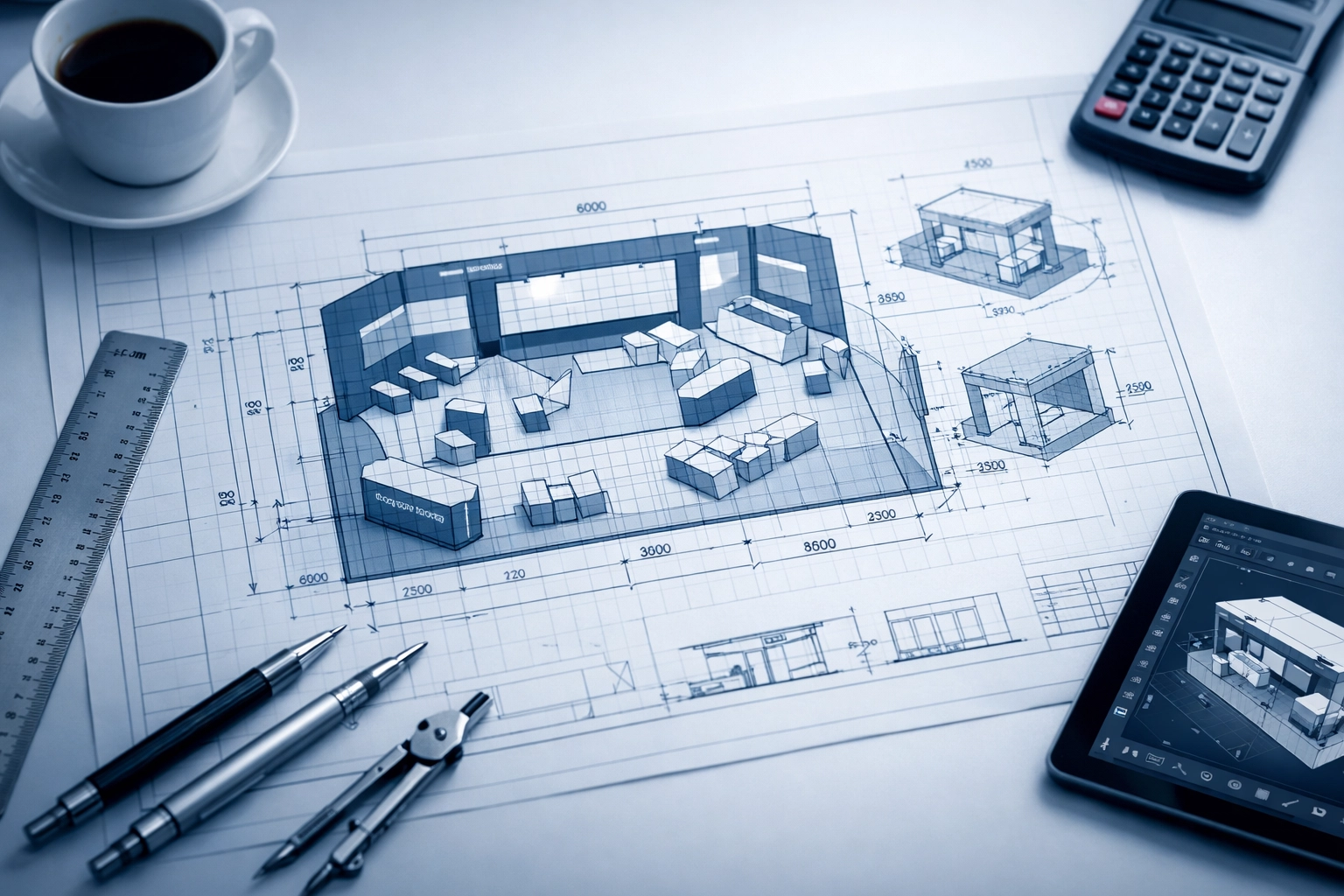
Once the technical drawing is locked, we move to the 3D render. This is where the client gets to see what they're actually paying for: and where miscommunication gets expensive if you skip it.
The render serves two purposes:
1. Client alignment. Is the stand they imagined the same as the stand you're building? Surprisingly often, the answer is no. Better to find that out at the render stage than at 9 AM on setup day.
2. A visual checklist. The render becomes the benchmark. If something doesn't match the render on-site, we know immediately. It's not about artistic interpretation: it's a quality control document.
And here's the thing: a BeMatrix render looks custom because it is custom. The modularity is in the system, not the outcome. You're still designing for the client's specific needs, branding, and spatial requirements. The frames just happen to be reusable.
Cable Management: The Unglamorous Hero
Let's talk about the least sexy part of exhibition builds: cable management.
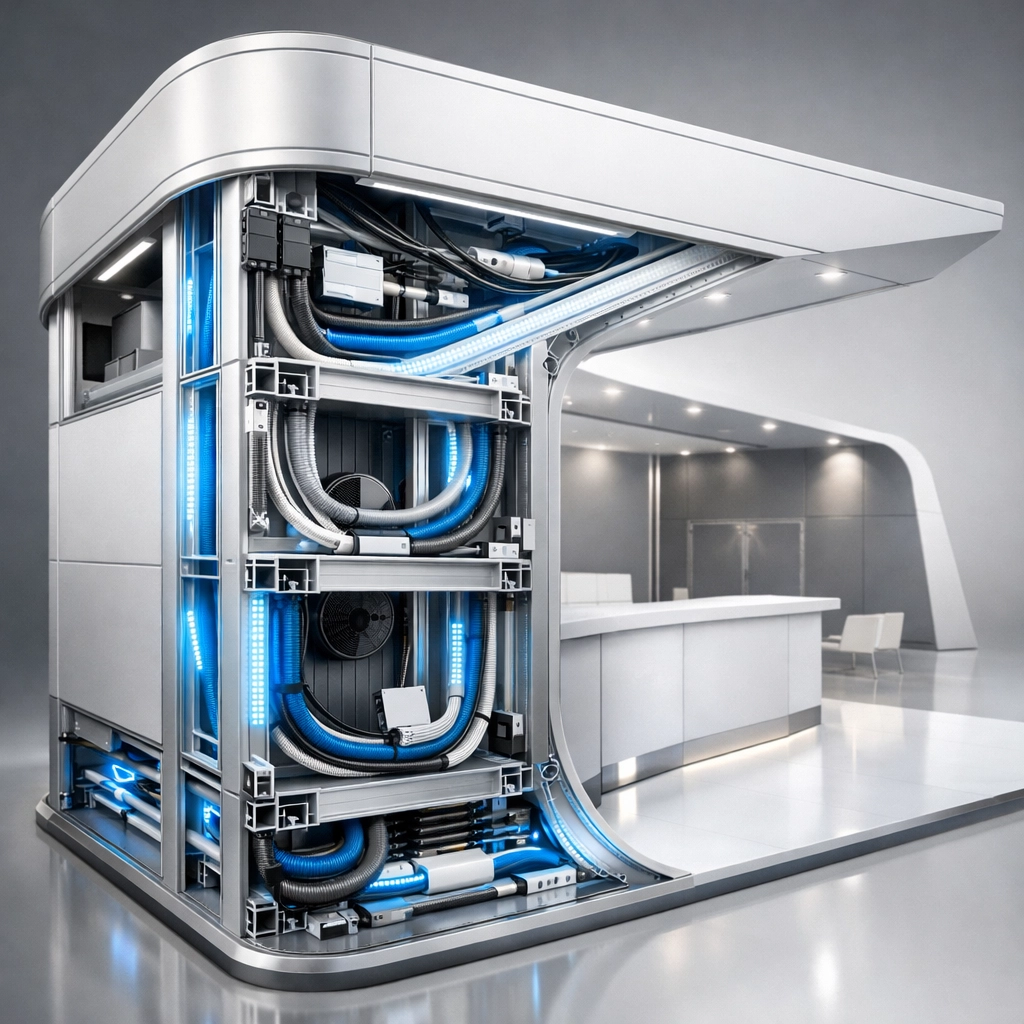
You've got power. You've got data. You've got AV. You've got lighting circuits. All of it has to get from point A (usually an ugly floor box in the corner) to point B (your beautifully lit branded space). And none of it can be visible, trip-worthy, or in violation of venue regs.
This is planned in advance. We map every cable run on the technical drawing. We spec the right trunking, the right fixings, the right slack allowances for when things inevitably shift on-site. We coordinate with the venue's power supplier so we know exactly where the drops are and what capacity we're working with.
And we do a full dry run in the warehouse.
That's right. The stand gets built once in our warehouse: not to "practice," but to confirm that everything we've drawn actually works in three dimensions. That the cables reach. That the panels don't block access to the power strip. That the LED strip doesn't interfere with the fabric frame tension.
Warehouse Prep: The Invisible Insurance Policy
Here's what happens in the warehouse before your stand ever sees a venue:
Pre-build and QC. The entire structure goes up. We check joint integrity, panel alignment, and graphic fit. If a frame's bent or a connector's dodgy, we catch it here: not on-site at midnight.
Labelling and batching. Every component gets labelled and grouped by build sequence. Box 1 is the base frames. Box 2 is the uprights. Box 3 is the infill panels. This isn't just organisational: it's speed. On-site, your crew isn't hunting for parts. They're building in sequence, as rehearsed.
Load planning. We know exactly what's going in the van, in what order, and how it's getting unloaded on the other end. Sounds basic. It's not. A badly loaded van can cost you an hour on-site. An hour on-site is an hour you don't have.
Graphic checks. Graphics are printed, hemmed, and test-fitted. We're checking colour accuracy, tension, and mounting compatibility. If a graphic doesn't fit the frame correctly, it gets remade before it leaves the building.
This warehouse session is your insurance policy. It's the reason a four-hour build actually takes four hours.
Logistics: The Part That Keeps You Awake
Even with perfect plans and a flawless pre-build, you're still at the mercy of logistics.
Venue access windows. Some venues give you eight hours. Some give you four. Some give you a two-hour slot on a Sunday morning and expect you to be out by noon. Your entire plan has to flex around that window.
Multi-site coordination. If you're running a nationwide rollout: say, the same BeMatrix stand going up in Manchester, Birmingham, and London on consecutive days: you need multiple sets of kit, multiple crews, and military-grade scheduling. One delay cascades into three.
Supplier coordination. If you're integrating AV, furniture, or custom elements from third-party suppliers, their delivery schedule becomes your delivery schedule. We build buffer time into every job because "the AV company said 2 PM" is not a plan you want to rely on.
This is project management at scale. And it's all happening before the van leaves.
Why This Matters (The Payoff)
So why go through all this? Why not just "wing it" on-site like the old days?
Because your margin for error is gone.
Exhibition schedules are tighter than ever. Venue access is stricter. Clients expect custom aesthetics without custom timelines or budgets. And if something goes wrong on-site: if you're troubleshooting cable runs at 11 PM or realising a panel doesn't fit: you're not just behind schedule. You're jeopardising the entire event.
The iceberg effect is about control. When 90% of the variables are locked down before you arrive, the 10% you're doing on-site is manageable. Predictable. Professional.
And that's the difference between a good modular build and a great one. It's not about the frames. It's about the 12 weeks of planning that made the frames look effortless.
The Reality Check
Here's the uncomfortable truth: modular builds are not plug-and-play.
BeMatrix is an incredibly versatile system. It's fast, it's sustainable, it's reusable, and in the right hands, it delivers a finish that rivals bespoke fabrication. But it's a tool, not a shortcut.
The companies that treat it like a shortcut are the ones scrambling on-site. The ones that treat it like a precision instrument: with the planning, the pre-builds, the technical rigour: are the ones finishing early and walking away clean.
That's the iceberg. The bit you see is just the tip. The bit that matters is everything underneath.
If you're looking for a modular build partner who sweats the details before the van even leaves, get in touch. We've been doing this long enough to know: the best builds are won in the warehouse, not the hall.
Leave a Reply