
We get it. You've just been handed the green light for ExCeL, NEC Birmingham, or kbb. The event is weeks away, and now you're wondering: How fast can we actually get this done?
The short answer? Six to eight weeks is the reality for a quality modular exhibition stand installation, and that's not us being precious about timelines. That's what it takes to engineer, pre-build, test, and deliver a stand that doesn't fall apart on Day 2.
The slightly longer answer? Yes, a two-week turnaround can happen. But it's an extreme sport. You need experts, zero margin for error, and plans that are 100% locked, loaded, and ready to roll before the starting gun fires.
Let's dig into why.
The 6-8 Week Gold Standard (And What Actually Happens)
Most clients assume the "build" is just the few days on-site when our exhibition stand build team arrives with the van. But that's like assuming a West End show is just the two hours on stage: you're missing the months of rehearsals, lighting cues, and costume fittings.
Here's what really happens in those six to eight weeks before we even touch a BeMatrix frame:
Week 1-2: Technical Render Checks & Forensic Planning
Your designer hands over a 3D render. Beautiful. But can it actually stand up?
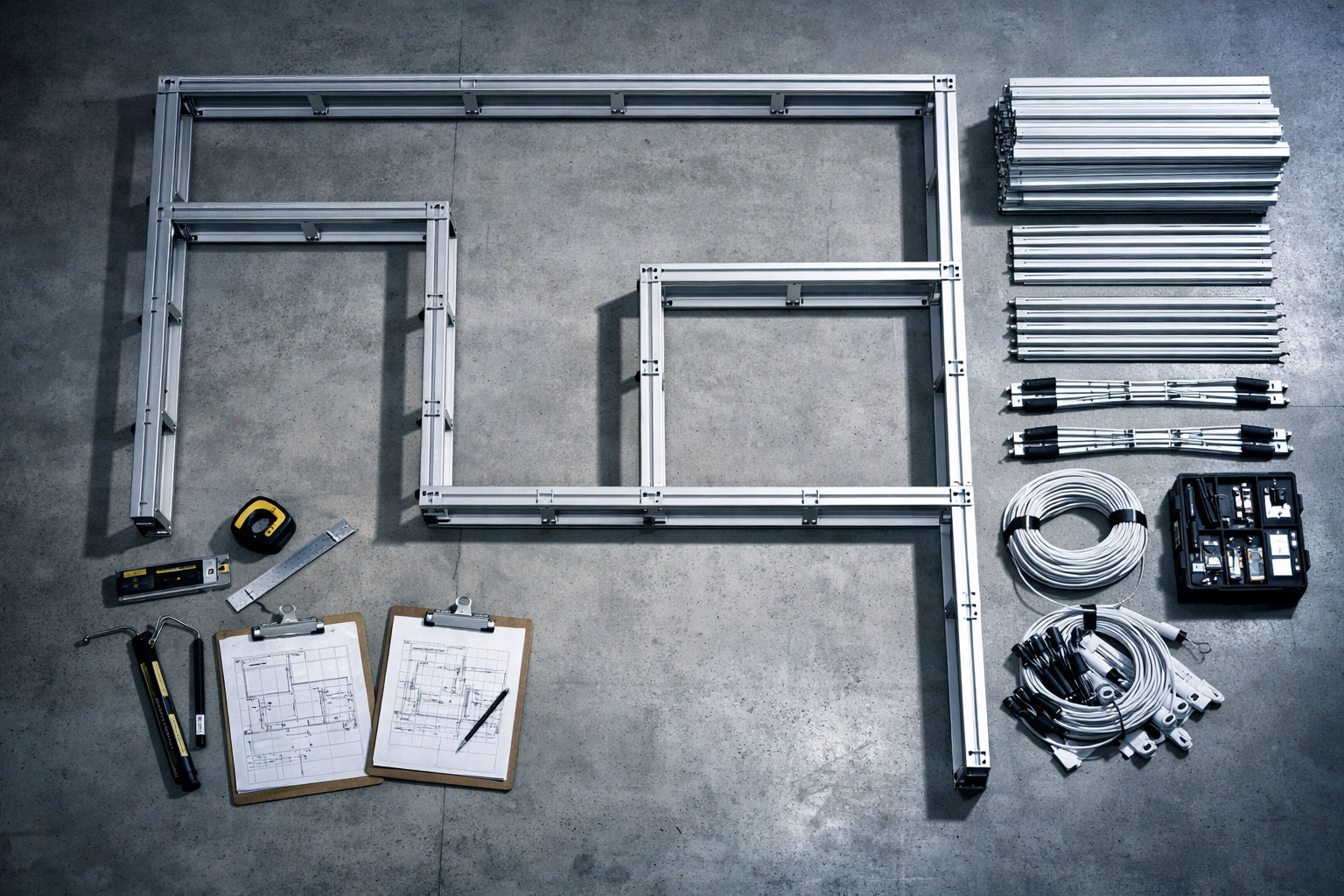
This is where our beMatrix installers go full forensic. We're checking load-bearing points, bracing requirements, panel weights, and whether that floating shelf you love is structurally sound or a lawsuit waiting to happen. BeMatrix is a brilliant modular system, but it's not magic: every frame needs engineering logic behind it.
We're also mapping cable runs at this stage. Where's power coming from? How do we hide the spaghetti of LED driver cables behind that lightbox? What about AV feeds, charging points, and that espresso machine the sales director insists on?
Week 3-4: Warehouse Pre-Builds
This is the bit no one sees. Before we arrive at the venue, we've already built your stand. Twice.
Our warehouse team assembles the entire structure: frame by frame, panel by panel: to make sure the kit list is accurate, nothing's missing, and the graphics actually fit. Because the worst time to discover a 3-metre graphic panel is cut to 2.8 metres? On-site. At 6am. With the show opening in four hours.
Pre-builds catch the gremlins early. Misaligned brackets. Incompatible frame sizes. That "custom corner detail" that looked great in CAD but doesn't physically work in the real world.
Week 5: RAMS, Risk Assessments & Site Surveys
Welcome to the paperwork phase. But it's essential paperwork.
As ESSA Members, we take health and safety seriously. Every job gets a full Risk Assessment and Method Statement (RAMS) before we set foot on-site. We're mapping hazards, access routes, working-at-height protocols, and manual handling plans. Because no one wants a call from the venue's H&S officer at 7am asking why your contractor doesn't have the right docs.
If the venue allows, we'll also conduct a site survey. Ceiling heights. Floor load limits. Power outlet locations. Rigging points. Lighting restrictions. All the boring-but-critical details that make the difference between a smooth install and a three-day nightmare.
Week 6-8: Logistics, Final Graphics & Kit Prep
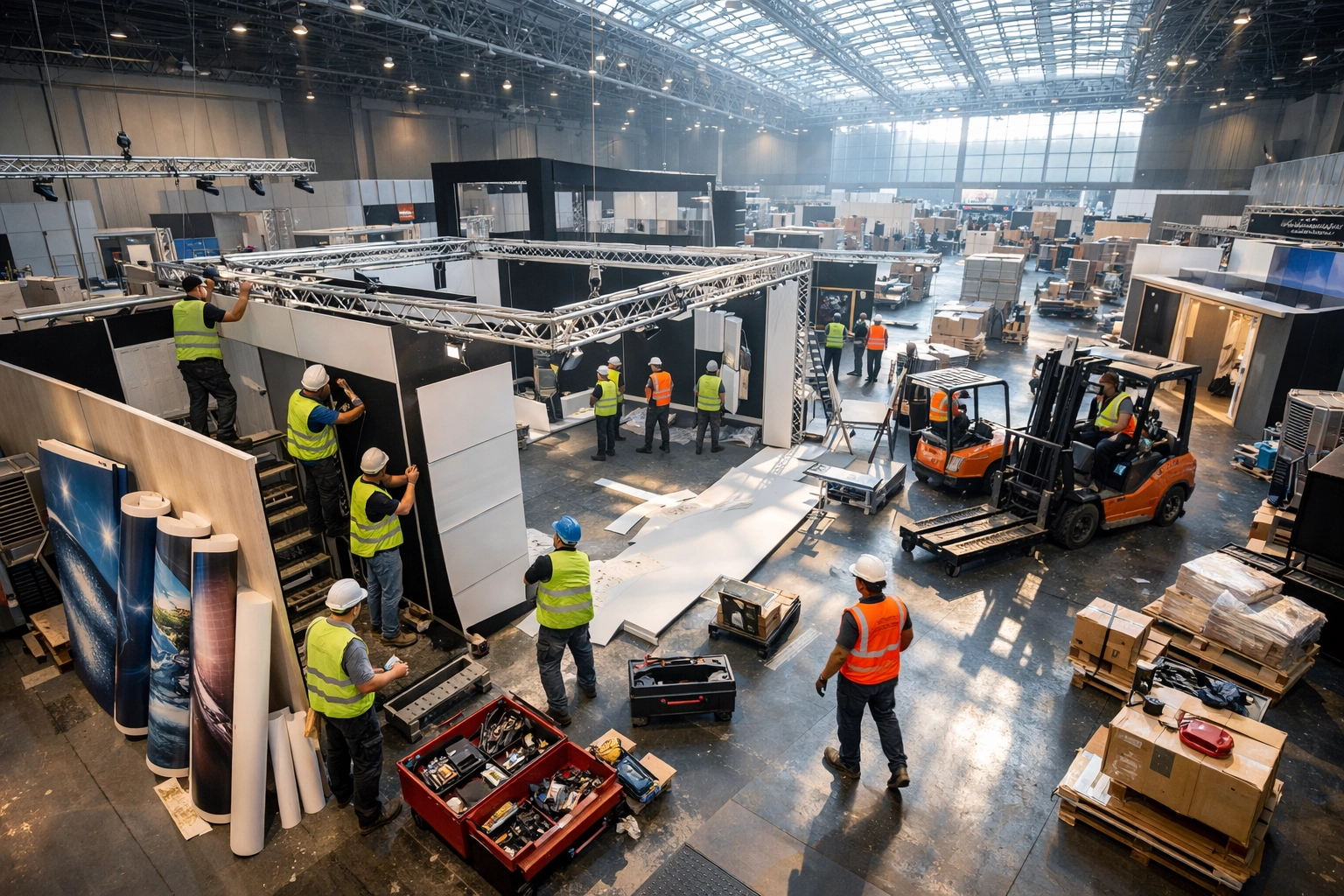
Now we're in the final stretch. Graphics are printed, trimmed, and checked. Hardware is packed. The load-out schedule is confirmed. Our exhibition stand labour team knows exactly who's on the job, when they're arriving, and what tools they're bringing.
We're also coordinating with other contractors: AV suppliers, furniture rental, florists, whoever else is part of the build. Because even the best stand is useless if the lighting rig arrives three hours after we've left.
By the time our crew rolls up to the venue, we've already done 90% of the work. The on-site build is the easy part.
The 2-Week Extreme Sport
So can it be done faster? Yes. But only if the stars align.
Here's what a two-week turnaround demands:
1. Plans are 100% locked.
No "can we just tweak the corner?" or "actually, we want to add a meeting pod." The design is final, approved, and signed off. No changes.
2. Artwork is ready to go.
We're talking print-ready files, correct dimensions, colour-proofed, and delivered on Day 1. Not "nearly there" or "we'll send the logo later." Ready. Now.
3. You're working with experts.
Specifically, exhibition stand contractors who've done this a thousand times and can troubleshoot in their sleep. Rookies need the full six weeks. We can compress timelines because we know exactly where the traps are.
4. The venue plays ball.
Early access. Flexible load-in. No surprise restrictions. If the venue suddenly announces a "no night-time builds" rule on Day 3, your two-week plan is toast.
Even with all that, a two-week build is stressful. There's no buffer. No room for a delayed graphic delivery or a last-minute design tweak. It's Formula 1 pit-stop levels of precision: thrilling if you're into that, exhausting if you're not.
Why Exhibition Stand Builders Worth Their Salt Prefer 6-8 Weeks
Speed is great. But quality is better.
When you give us six to eight weeks, we can deliver a modular exhibition stand installation that looks sharp, functions flawlessly, and doesn't require three emergency service calls during the show. We've tested it. Pre-built it. Checked it twice.
You also get better communication. More time means more opportunities to refine details, ask questions, and make sure everyone's on the same page. Rush jobs mean decisions get made in the van on the way to the venue: not ideal.
And let's be honest: a calm, well-planned build is a better experience for everyone. Our exhibition stand build and dismantle crew isn't scrambling. Your marketing team isn't panicking. The client isn't stress-eating Mini Cheddars in the corner at 10pm.

The BeMatrix Advantage
Here's why we lean heavily on BeMatrix for these jobs: it's modular, reconfigurable, and engineered to professional standards. Unlike some systems, BeMatrix frames are designed for speed and stability. That matters when you're building a 6m-high wall or a cantilevered reception desk.
It's also a system our team knows inside-out. We're not figuring it out as we go: we're working with a platform we've installed hundreds of times. That expertise is what makes the two-week turnaround even remotely possible.
But even with BeMatrix, you still need that 6-8 week runway for anything custom, complex, or client-facing.
So What's the Right Timeline for You?
If you've got a tried-and-tested design, all your ducks in a row, and a team who can move fast: sure, let's talk about two weeks. We've done it. We can do it again.
But if you want a stand that's been engineered properly, pre-built, tested, and delivered without drama? Give us six to eight weeks. It's not about being slow: it's about being smart.
And if you're wondering whether your timeline is realistic? Get in touch. We'll tell you straight.
Because at Event Lab Collective, we'd rather deliver a brilliant stand on a sensible timeline than a rushed one that keeps us both awake at night.
Leave a Reply